Tuesday, May 31, 2016

Garden Therapy vs. Physical Therapy, and Quad Awakening

This weekend was miserable weather-wise, and otherwise. Claire Adele was out of town for half the weekend on a band trip to Canada, and Jack was working Friday night and Saturday on pager call. The Boy was around, which was a mixed bag. At times, he is fun and pleasant. At other times, he is a major grumpus. We saw a bio-pic of Pele, which got panned by reviewers as a boring bio-pic, but we liked it. We also ran some errands, like going to the library to pick up some books and stopping at City People's Mercantile.

There is nothing worse than a long weekend with no plans and mediocre weather. Boredom and her brother, the Black Dog of Depression, started to visit me. It is easy to get a little despondent with feeling trapped by a mediocre knee. It doesn't help that I just started reading Imagine Me Gone by Adam Haslett, a novel about suicide and depression.

It was rainy and gray Saturday and Sunday--not good for getting outside, not that I could do a whole lot. I guess I can, but as one of Jack's colleagues said about recovering from an ACL repair -- first comes the range of motion, then strength, then confidence. I am stuck between the second and third. I still am working on my strength. Suppose I could go kayaking, canoeing, hiking and biking, but I have to think about my knee so much that I am not sure if I would have fun or spend more time thinking about how to move my knee. Canoeing would be fine--once I got in and out of the canoe. Golf, tennis and standup paddle boarding would be out of the question.

The Boy, as much as he hates his sister, actually missed her. If nothing else, they give each other something to do, even if it is argue and bicker. He'd rather argue with her than talk to us. I helped him download music from my computer to his phone. He plugged his earbuds and was tuned out for half of the weekend. I am not sure what will happen when Claire Adele is gone for four weeks this summer.

I needed to push the Black Dog aside, give it a kick in the ribs. The weather was finally beautiful on Monday, so I got out to do my favorite kind of therapy: working in my garden. Like the cleaning the Boy's lego room, I needed to bend and squat to garden. I didn't plan to work on the whole yard for half the afternoon. It started out small. I saw a weed that needed to be pulled. It is just one weed, I thought, and then two hours later I'm covered in scratches and bug bites and have a large tub of yard waste filled, raspberry bushes pruned of dead branches and all forms of non-invited plant species gone. And that was just the backyard. I thought about starting the front yard, but that would require far more bending and squatting. My neighbor across the street knows I haven't been able to work on the yard. She offered to have some of her friends who do charity gardening come and take a whack at my parking strip. Like sorting Legos, gardening is one of my favorite mindful/mindless activities. It makes me feel productive and like I have accomplished something. Unlike sorting Legos, there is a visible reward for my efforts and I get Vitamin D.

Like many of my physical therapy activities, I feel fine while I am doing them--it is the aftermath that kills me. This morning I woke up and instead of my knee not wanting me to get out of bed, it was my lower back. I slept just fine--thankfully no problems there. I had an 8:00 a.m. physical therapy appointment, and I couldn't move much. I continued to sleep, then got up and took a fifteen minute epsom salt bath for my back as well as two ibuprofens. It seemed to work.

I needed the garden therapy, though, even it messed up my physical therapy. A day in the sun succeeded in chasing away the Black Dog for now.

I went to physical therapy and complained to Evan about my back. I also told him Jack isn't thrilled that I can't walk down stairs properly yet. He booked a place on Mt. Saint Michel in France that has seventy steps to get to the hotel. I have more than two months before we go, but he is very interested that I can easily navigate the steps. I asked Evan about it.

"You are a little behind in that since you don't have enough quad strength yet," he said. " Your knee cap isn't moving fluidly enough to manage the stairs."

Evan seemed to take it easy on me at first, but was still concerned about my left quadricep not firing properly. I practiced going down stairs with their double handrail steps. Each week, we run through new exercises to see what will work on my thigh. Thanks to many years of dance and yoga, I can easily recruit other muscles to do the work of my thigh. The problem with that is then my quad doesn't build the strength it needs to be do things like walk downstairs or run. Today, we hit the jackpot--I hope. He had me hang on a ballet barre, take a deep squat and stand.

"Use your quads, not your hips," he said.

Voila, I felt my quads working! I felt like Hellen Keller when she first understood Ann Sullivan making the "water" sign in her hand. Evan seemed happy. This was what I was supposed to be feeling for all of those other exercises. Now I am supposed to do a million of these exercises everyday. The only other time I have felt my thigh so fully engaged was, ironically, when I ski, which is what got me here in the first place. I thought about telling Evan, Hey, I can ski to get my quad back! Then I imagined his smile, common to those raised in the Midwest when they hear something ridiculous, the smile that is a combination of "Oh you are so cute so say something so absurd" and "WFT -- You are crazy."

And the double bonus: the same exercise that helps my quad also helps my back. The moral of this story is I need both mental health and physical therapy to get where I need to go, even if one kind of therapy temporarily sets me back in the other.

Saturday, May 28, 2016

'Til Death do Us Part vs. Lonely Seniors Die Sooner

I was flipping through the notes section of my iPad the other day and I found a quotation I had electronically jotted down:

Lonely Seniors Die Sooner

I saw this several years ago on the side of a cab or a bus in Vancouver, B.C. when I was there with friends. I think the quote was a part of a United Way Campaign. I jotted it down for the Boy. At the time, he was part of a First Lego League (FLL) team and the theme was "Senior Solutions." The goal was to create a project that would made seniors feel more connected, independent and engaged.

I think about my Dad. Which should he abide by: 'Til Death Do us Part or Lonely Seniors Die Sooner?

I was talking to my friend, Eleanor. She is ninety-five, a year or two younger than my grandfather would have been if he were still alive. She asked about my recent visit to my parents.

"My mom recognized me, I think," I said. "She smiled as if she recognized me when she saw me. It was better than my visit in January when it took her awhile to figure out who I was.

"My father visits her everyday and spoon feeds her lunch. His goal is to get her to eat and drink," I said.

Eleanor says whatever comes to mind. If she changes her opinion, she is quick to share that, too.

"He views her as a child, an infant," she said. "He still may love her, but he can't see her anymore as his wife."

Eleanor doesn't know my parents specifically--her opinion is based on data she has collected over decades. Even still, I had never thought of my parents like that. Whether or not it is true, it is a fact my father is lonely and my mother isn't in a position to meet his needs. He can feed her and try to make her smile, but that is about it in terms of him meeting her needs. My father told Jack that he thinks my mother views him as one of her many caretakers. My mother first forgot she was married to my father years ago. They were in Florida for a few weeks in the winter and she asked him where he lived and told him abut her kids. He was shocked that she didn't know they were married. When they returned to Ohio, she understood she was married to him, but it would come and go, like someone losing a radio signal when driving out of town. There might be a blip for a few seconds when the station is gone, but then it comes back, slowing fading into static.

So where does this leave him, in this horrible middle ground of being married and being single at the same time? "'Til Death Do Us Part" was written in an era when the average marriage lasted a short time because one of the partners would either die in childbirth, of disease, or in war. They didn't expect there to be this extended phase where people's bodies outlive their minds. My dad said he felt like he was abandoning her when he left her at the Memory Care Unit, but her daily living needs exceeded what he could do. At what point does he get to have a life?

Part of me thinks it would be okay for my dad to seek companionship. My mom hasn't been an equal partner for a long time, and as the ad on the bus said, "Lonely Seniors Die Sooner." The other part of me wonders about practicalities and logistics. While my friend Eleanor thinks that a man in my father's position wouldn't think of a woman he spoon-feeds as his wife, my father might be the exception. Is it fair to another woman to live in my mother's shadow? What would happen to the woman he is dating when my mother dies? How would he grieve?

The bigger issue this raises for me has nothing to do with my parents: it has to do with me and Jack.  I worry less about Jack wandering to the fog than me. When would it be okay for him to start dating if I were the gomer? I fear giving my dad my blessing as Jack might assume I am giving him the same blessing decades in the future, but without the same parameters. Would Jack feel free of the bonds of marriage the day I forget where I was yesterday? The first time I forget who he is? I fear I might get dropped much sooner than might be considered appropriate or reasonable, if there is such a thing. I don't want to be abandoned if I were to decline into mental decrepitude. For my mother, it was a slow and gradual decline. She would forget, but then she would remember.

I told my father my fears that Jack might abandon me at my first whiff of senility.

"I don't think so," he said. "You really don't know how you will respond to that situation until you are in it."

Bizarrely, my mother probably has a better social life than my dad. She is surrounded by caretakers, nurses and other residents of the Memory Care Unit all day. She eats three meals a day with her friend Kate and she hangs out in the living room with the other residents most of the time. Loneliness won't be the cause of my mother's death. But what about my dad?

Friday, May 27, 2016

Strangers at the Gym

Strangers at the gym, sweating profusely
Sweating through their clothes, scaring me deeply.
Could they have the flu? Or are they just working hard?

Something in their eye was kind of glassy
Something in the air was kind of gassy
Something in the room made me need to leave.

Strangers at the gym sharing too small a space
Strangers at the gym...

I am sure there are people at the gym who might think I am a little odd with my big blue bag, lots of books and a little limp. When people ask about my knee, I tell them the truth, when they really might want to hear "It is great!" I get it. The gym is a public place where people publicly hide in their own little mental cocoons while they exercise, myself included. People come in all shapes and sizes and unspoken rule is that I won't pass judgment on you if you don't pass judgment on me. We are chose to herd ourselves into these rooms with a high density of equipment and pound away.

I hereby am going to break that rule. I am sorry. Call me horrible names. Again, I am sorry.

A few days ago, I was at the university gym, working out on the elliptical next to my favorite bike. There are about six or so cardio machines in this small little corner office window area on the fourth floor. I love working out there. I consider that bike my bike, and I am completely neurotic about needing to ride it. As I have mentioned before, it is far from the television screens and has a great view for a gym.

The corner office at the gym

I got to the gym early Tuesday morning. When I got there, there was a middle aged man riding an elliptical in my corner office a few machines down from mine. He had a little buffet lined up on the machine: an orange, carrots and dip, granola bars, water bottles. The water bottle makes sense. Granola bars? Check. An orange is a little different, but okay. It isn't like he is biking to Portland, but whatever. The carrots and dip? What?

He was also very sweaty. His shirt and pants were soaked. I thought, He is near the end of his workout. He has probably close to being done. After about fifteen minutes, he kept going. He would pause for a minute, then continue. I have seen him before but never so sweaty. I wonder if he was on some new kind of medication or if he needed medical attention. I thought about asking him is he was okay, but his posture was good so I figured he was at least under his own control. If he was slumping over the machine, grabbing his chest or having problems breathing, then I would have gotten someone at the front desk.

He paused, and wrung the sweat out of his shirt. A puddle was appearing under his elliptical. Surprisingly, he didn't smell that bad at first--he must have had a clean sweat where all of his salt and other chemicals came out before I got there. As time wore on, a slight odor was starting to waft over in my direction. After a half an hour, he showed no signs so slowing down or stopping. I had to move. I had to leave my most favorite corner because I was grossed out. My sanctuary had been invaded and violated. The best part of working out was this corner of the gym, or so I believed. I went down to the main floor and found a recumbent bike and finished my cardio. I was sad, but also realized that exercising on the main floor wasn't too bad.

Wednesday night, I went to the Pacific Northwest Ballet's studio rehearsal. Jack reminded me that my favorite dancer, James Moore, sweats a lot. How could I be so critical of this poor guy next to me at the gym and not James?* Does a professional dancer get more slack than a duffer at the gym? Unfortunately, yes. I guess that makes me a bad person.

"Moore puts a towel around his neck after he dances," I said. "Plus, he seems to manage his sweat. If he makes puddles, he or other dancers could slip and fall."

I decided I'd go back to the YMCA for the week. This morning, I was walking past a house on the way to the YMCA when I saw a man on this front steps. He was smoking and his eyes were a little glassy.

"Good luck with your ankle," he said. I winced. Dang,** I thought. Even this stoned guy can see my limp. I had been working really hard to walk without a limp and I was a little depressed it was called out. It turns out he has an injured and swollen ankle, and was offering me support. It was sweet, but a little odd. (My son said he must not have been that stoned if he noticed my limp.)

Then I got on the bike. There was a very nice man on the bike next to me, who was sweating less than the guy at the university gym. This guy would have had an impressive amount of sweat if he hadn't been beaten out earlier this week by the sweatiest man I have ever seen. I thought of offering this man a towel, walking over to the stack provided by the Y just for that purpose, but I couldn't. Sure, James Moore uses a towel, but that doesn't mean this man would appreciate my gesture. At best, he would have been embarrassed, at worst, he would have been highly offended. I smiled, and let him sweat.


* I'll help you skip the google search for James and give you the link.
** My father thinks I need fewer f-bombs on my blog.

Thursday, May 26, 2016

Surface Tension, Part 2, and Two Steps Forward, One Step Back

Elliptical Time: 15 minutes
Bike Time: 30 minutes

When I was in Ohio visiting my parents two weeks ago, my friend Betty asked hope I was coping with all of the stuff in my life right now. Last night when I was at dinner with a friend, I figured it out.
  1. Forty-five minutes of cardio everyday, seven days a week.
  2. My dog, Fox.
Today, I was on my way out the door to workout when a friend called. I haven't talked to her in a while, so I picked up the call. We chatted, but by the end of the call, I was getting anxious: I needed to workout. I was surprised by the feeling. In my pre-injury life, I would have been happy to have a phone call from a friend to distract me from working out. I thought I was working out just because I had to to get my knee fully functioning. Nope. I now need it for my sanity.

Last week, I added the elliptical into my daily physical therapy work. The surgeon told me to add five minutes at a time. I took him quite literally, and added five minutes a day. The elliptical is supposed to be a more advanced workout for my knee because I am bearing weight, not just spinning my legs around like I do on the stationary bike. The stationary bike is good for recovery for exactly that purpose: it gets the leg moving without the stress of having to carry the load of my body. I forgot the advice Jane from my physical therapy team gave me earlier in the year: when adding a new exercise, don't increase the amount you do by more than 50% a week. There must be a sweet spot between what Dr. Tex recommended and Jane's advice, but I passed it.

This Monday, I did twenty-five minutes on the elliptical. I felt fine while I was working out, and I did the remaining part of my forty-five minute cardio routine on the bike. I thought my leg was fine with adding the elliptical. I am now able to walk downhill while bending my leg, and Jack says my gait has noticeably improved since last week. Monday afternoon, my left leg was exhausted. It refused to do the weight lifting exercises and isometric exercises at home. Enough! is screamed at me. Give me a break! 

I told Evan about how tired I was and my elliptical experiences. I feel like I took two steps forward and one step back. I am usually cautious and take a conservative approach to healing: I am not comfortable pushing myself to the point of pain. Evan was sympathetic. "It is okay to push yourself hard, but your leg will get tired," he said. I am back to icing my leg three times a day, and I've pull back my elliptical riding to fifteen minutes a day for the next week. 

There is another upside to riding the elliptical in addition to the fact that I walk better: the time between the elliptical and the stationary bike is a great time to lift weights.

Wednesday, May 25, 2016

Ambient Pressure

In December 2015, The Atlantic published an article by Hanna Rosin about a cluster of suicides at Henry M. Gunn High School in Palo Alto, California. I read it at the time, and thought about it this week at it pertained to the Boy. Rosin uses Gunn as her example, but says the pressure kids face there isn't much different than pressures faced by kids in high-achieving schools in affluent neighborhoods in New York, Dallas or Seattle. One of the quotes from the article was "Gunn is a distillation of what elite parents expect from a school." While I haven't seen the movie Race to Nowhere, it is about the pressure affluent kids with high achieving parents face to do well in school and get into a good college.

But is it really the parents or the school that are pressuring the kids? Am I pushing my kid to succeed and is that what is driving him to such high levels of stress? My guess is no. Like most parents, I just want my kids to be happy and successful at whatever they do.

In some ways, I wish the Boy would grow up to be a movie director, as that was a dream I had for myself in my twenties. Sometimes I wish Claire Adele would become a romance novelist when she grows up. She has written some really nice Gothic romances for school assignments. Maybe she could turn one of them into a book? I never told the boy about directing films--he is way too interested in rocket and robots and things that fly to take an interest in movies beyond enjoying watching them. But my dreams aren't theirs and vice versa.

I would say the pressure kids feel is ambient--it is just there in the community. It isn't so much what we say that causes the pressure--it is who we are. People for thousands of years needed to fit into their tribe for safety and protection. Modern teens are no different, except our tribes have become much more stratified and less hetrogenous. The school doesn't directly put pressure on the kids, but everyone heard about the awards the eighth grade band won at the competition last weekend. What happens when this year's seventh graders don't do as well next year?


Plus, the Boy has the own pressure he puts on himself. PTA's mission is "Making Every Child's Potential a Reality." It is a beautiful and simple mission. But what if a child's dreams exceed their ability? What if their ambition exceed their potential? Not every kid who aspires to an Ivy League college or medical school gets in. What then? How do we let these kids know that even if they don't become a doctor or architect or own their own business that things will be fine? That it is okay to be a carpenter, an electrician, a car mechanic or a UPS truck driver? We can tell them that, but will they believe us when they see otherwise? I pick those career examples because I know intelligent, talented and hard working people who do those jobs, and we need stuff built, fixed and shipped. But with rising rents and real estate costs, you better go to a good college and get a good job to afford to live here. How is that welcoming them into the tribe?

Fox: The Prodigal Dog -- A Haiku

Fox leaves the backyard.
The bad dog returns home, then
Expects a party.


Sunday, May 22, 2016

The Elliptical, Ice and Neurosis

Elliptical Time: 20 minutes
Bike Time: 25 minutes 
Motto: Every minutes on the elliptical is a minute I don't have to spend on the bike


I saw Dr. Tex last week. We had a nice appointment. His conviviality continues to improve. His healing approach is a little different than Evan's, but that is okay. A few weeks ago, I complained to Evan how bored I was on the stationary bike. He had hesitatingly suggested I could start riding the elliptical. I decided I'd wait until I got a more ringing recommendation. Last week, Dr. Tex said I was healing nicely and I could swim, ride elliptical, hike, etc.

"When you start on the elliptical, add five minutes per session," he said. "Don't start out riding is straight for forty-five minutes. And ride the elliptical first and finish up with the bike. You don't want to start something new when you are tired."

This would add some weight bearing activity to my exercise plan, which I need. We are going to France in August, and I need to be able to be on my feet and walk around for ten hours a day. Plus, old hotels in France don't have elevators. I will need to be able to schlep my luggage up and down stairs. We will be staying at a hotel on Mont Saint Michel and I'll need to navigate seventy steps to get there. This is noted in the details about the hotel. Staying on Mont St. Michel will be incredibly cool. I need to get into shape. I didn't realize how much this trip would motivate me to be aggressive with my physical therapy. I generally tend to be patient and think I'll get there when I get there.  Not so much anymore.

"Keep icing the knee for another month," Dr. Tex told me. He means ice it three times a day for ten to fifteen minutes. I haven't been icing my leg lately--I don't know why. I think after the surgery, the ice made my feel dramatically better. After a month and a half, my leg would still be swollen and stiff after I iced it, so I kind of failed to see the point of sitting there, leg straight, for fifteen minutes three times a day.

This week, I spent a few hours a day sorting Legos and mediating in the Lego room. I didn't know my knee would get so stiff from sitting and bending and having limited movement, but it did.  Yesterday and today I iced it, and it felt better. The plum was almost completely gone. I am reconvinced that I need to keep icing it. I feel kind of bad for Evan--he has been telling me to keep icing it, and I blew it off. Now the surgeon tells me to ice it, and I listen. In fairness, this week I have been working my knee harder with the elliptical and sorting Legos. But I guess that is the point: I am supposed to continually work the knee harder, and therefore I will get sore, and therefore, I will need to ice my knee. Evan said something to that effect Friday. I finally get it.

While they agree on the ice, Evan and Dr. Tex sometimes have different opinions. I asked Dr. Tex if I could ride a road bike, and he said yes. Sweet! I thought. Evan said I could, but not on the Burke Gilman Trail, not in the U District where I live and not on hills, which is all of Seattle. In short: no. I have to admit, asking Dr. Tex about riding a bike was a little like asking Dad for something when Mom has already said no. When I told Evan what Dr. Tex said, Evan had a painful smile on his face.

"You are wincing," I said.

"Just don't fall," he said.

Dr. Tex also said I could reduce my physical therapy appointments to "once every three or four weeks." I just about choked. Theoretically, I want to be in good enough shape that I can ski again. I won't get there if I have to make up my own fitness routine. I also need to be monitored to make sure I am on track. I told Evan this, and he agreed with me.

"I had a friend who stopped physical therapy after his ACL surgery, and he still limps," I said. Evan knows I loathe the idea of limping.

"Yes," he said. "Most people benefit from a structured program and support."

Yesterday, I was working out at the university athletic center. As Dr. Tex told me, I am supposed to ride the elliptical before I bike. As I have mentioned before, I like riding a bike on the fourth floor in a corner by the floor to ceiling window overlooking the soccer fields, the baseball stadium and Lake Washington. I consider it my bike, which I know is completely insane. I get a little possessive about it. Evan and my daughter both think I need to ride the bike for five minutes to workout, then lift weights, and then go back to the bike.

"You need to warm up before you lift weights!" Claire Adele told me. "You could get hurt!" Apparently the athletic trainer at the high school sufficiently drilled this message into her head. Evan is concerned that I am too tired after forty-five minutes of cardio to get the strength training in. The real reason I can't do it is because I might lose my bike, and that would be horrible. The other bikes are in a pod surrounded by silent television screens. From the screens, I could watch The Price is Right,* CNN's murder of the week, or sports or talk shows, all of which make me depressed. I need my screen free bike.

So Saturday I get to the gym. Here are all of the other bikes and cardio machines on the other side of the track across from my bike:

Nobody riding bikes or doing cardio
No one is there. Nobody. That is why I could take this picture (sorry it is blurry) because no one was there. There was only one person in the whole area, and he was riding my bike. It was horrible. I rode the elliptical next to my bike. Most people at the U sports center don't ride for forty-five minutes like me. I was lucky this man finished riding after ten minutes so I could grab the bike when he was done. Something similar happened to me Friday. There was an older gentleman on my bike, and he would get off the bike every three minutes to stretch. Each time he got off the bike to stretch, I was ready to jump off the elliptical and grab my bike. I am glad I didn't otherwise I would look like a nut.

After riding the elliptical, I am starting to feel stronger. I was able to walk down hill yesterday while bending my knee. This is a major milestone. I am still slow going down hill, but at least I don't look like Frankenstein.

One more thing: With all of this indoor exercise, I am not getting tan. We've had a sunny spring in Seattle, and I've missed the sunshine.

* I like Drew Carey, but not enough to watch a game show.

Friday, May 20, 2016

Relative Empathy

Last week, I was at a luncheon where former Congresswoman Gabby Giffords and her husband Mark Kelly spoke. Kelly did most of the talking as Congresswoman Giffords had a difficult time speaking as a result of injuries from being shot in the head. I didn't realize the degree of her disability. She seems bright and cheerful in photos. She smile might be a little off, but other than that she looks healthy. It seemed there was a struggle behind each word she spoke. She has a difficult time walking. It seemed that attending this luncheon with 1,500 was exhausting for the guest of honor. It probably was not as exhausting as the month of therapy while she was recovering from a gunshot wound, but exhausting nonetheless.

Kelly made a comment towards the end of his speech. He had recently had surgery on his arm after he had a pole vaulting accident. ("Yes," he said. "Pole vaulting.") He was complaining about his arm one morning over the breakfast table, and he said Giffords replied, "You have to be frigging kidding me."

This made me think of relative empathy. Can we have empathy for those who are suffering less than us? Clearly, getting shot in the head is way worse that hurting an arm, but for the person whose arm is hurting, it is still a big deal when they can't get dressed or make lunch. They might have pain, even if it is temporary. Are they not allowed to complain? Are we in a competition of who hurts the most?

I hope not. And yet...

It can be hard to have empathy for people who are struggling with problems far less complicated than our own. To be clear, I am not talking about people who are whining about imaginary problems. Jack is growing through a challenging time in his job. To outsiders, it would appear that he is fine, but he is disappointed in himself with some aspects of his own work. The job he has now has so many tasks and expectations that he can't possibly do them all, so he picks what he thinks is in most need of attention. His focus tends to be on the good of the organization while neglecting his own development. He worries about the long-term implication for his career by sacrificing other external parts of the job.

I have been a volunteer, a stay-at-home mom and a budding politician for the past sixteen years. I feel like Gabby Giffords listening to her husband. Jack is worried about whether or not is career is perfectly awesome, whereas I don't even have one.

But then people who are suffering health-wise from issues far greater than a torn ACL might not think I have reason to complain. I was told by one friend I injured myself doing a leisure activity. I am fortunate enough to have time and money to ski, and I have good health insurance that pays for surgery and physical therapy. Jack and I have saved enough money for rainy days that we can pay the out pocket expenses without deciding which bill we won't pay that month or charging it to the credit card. Then again, Jack has a good enough job that we can afford to save money and still take vacations and ski. We still make choices. We drive old, used cars. I wear old clothes. We live in a small house that had what my friend Sarah gently called "deferred maintenance."

To be clear, I am not complaining. Of all of the problems in my life--mother dying of Alzheimer's, a son who struggles with adolescence, a knee that isn't fully recovered--money isn't one of them. When I look at my life, I could easily say it could be better, but it could be worse. My mom didn't die when I was twelve. My son recognized he has some problems, and that gives me infinite hope that he will pull out of this tailspin. If one were heartless, one could say, "All parents die. Being a teenager sucks. Middle age people have bodies that fall apart. What's new?" Well, this is all new to me, even if collective humanity has been experiences these things for ages. I've never watched my mother die, but Roz Chast has, and she wrote about it in Can't We Talk about Something More Pleasant? I got it from the library Saturday, and I've read it twice. Having empathy gives us to the chance to learn about things that haven't yet happened to us--yet.

I haven't been to church in a million years, but I think of the song I heard growing up, "Whatever so you do, to the least of my brothers, that you do unto me." I understand the sentiment. Those who are hungry or homeless or ill or other otherwise suffer need an extra dose of compassion and support from those who have more to give. Yet, I thought it was kind of weird that we would figure out who is "less" than us. Is that condescending? Do we need to compare? I have a friend from college who married a man who became very wealthy. She is tall, thin and athletic. She has two beautiful, intelligent sons. On the surface, she really has nothing to worry about, but she still has worries, concerns and problems just like the rest of us. One of her problems is people telling her she doesn't have problems and she should just shut up. I think that is incredibly harsh, and frankly wrong. Who am I to say she doesn't have problems?

Or, is this why we have tribes? Is this why tall, skinny, rich women tend to have tall, rich friends? Because they can give each other and get back empathy? Does this apply to everyone?

Maybe the point is empathy is empathy, all the way around.

Wednesday, May 18, 2016

Sorting, the Lego Room and My Left Knee


Elliptical Time: 5 minutes --took a while for my knee to make it around
Bike Time: 40 minutes 


There are lots of things that I used to be able to do before my skiing accident and knee injury that I am still working my way up to doing. Today, I hit a new milestone.

The Boy has a lego room. It isn't very big--it is part of a converted attic space next to the Boy's bedroom, which is also converted attic space. This is what the lego room looked like this morning:

Before

As you can see--or as you cannot see, there is a carpet under my son's 40,000 lego piece collection. I bought this rug before the Boy was born. It was a rug I had coveted from Pottery Barn kids for ages, and I finally bought it when it went on clearance. The floor in the room in St. Louis was awful, so I covered it with this rug.

Rug in the Boy's room in St. Louis
I don't mind clutter and mess. I would photograph my desk as Exhibit A for disorganization, but I don't want to. 

I do, however, mind wool moths. These are little moths that eat wool. I hate them.

Two horrible moths that are laying eggs in this rug. These moths are now dead.

These tiny bugs and their larva have made big holes in this rug. The best way to get rid of the bugs it to vacuum the rug, but the Legos first need to be cleaned up.

These are the moth holes.
The Boy got his first Lego set when he was four. By time he was five, he had several Lego sets. He is a builder and a rebuilder. Very few sets stay completed as designed. They get taken apart, re-organized and rebuilt in to a million other things. I am happy to support my son's Lego habit. Since he spent so much time in his Lego room, the way for me to spend time with him was to go to the Lego room. I am not much of a builder, so I became a sorter. I sorted his Legos by type, and put them in bins. Some of the bins were from an old Target toy shelf from Claire Adele's room. Others I bought at fancy organizing stores. He has a fishing tackle box to store tiny, one of a kind pieces. I also re-use plastic rice and ice cream containers for Legos.

Ice cream containers. I mostly bought the ice cream because I thought the packaging would be good for storing Legos. Seriously.
Sorting Legos became my hobby. It is a mindful/mindless activity like knitting or needlepoint, except I don't get a nice sweater or pillow at the end. Sorting Legos is more Sisyphean -- once you are done, the Legos get unsorted again and it starts all over, like knitting a sweater that becomes slowly unraveled while you work so you are never done. But the goal isn't to be "done." It is to make this massive collection accessible. We have downloaded instructions from sets he doesn't have and built them. He had books on building. And of course, he makes his own creations.

Yet, it was peaceful and cathartic to sort piles of Legos and have them easy to find. My sorting isn't beautiful, but it is calming. After I lost the School Board election, I was in the room sorting Legos. It was December, the week before my skiing accident. The sorting was not as relaxing as it usually was. Before, it was a productive mental escape. I could take a mental vacation and still accomplish something, even if it was small. Now, I don't have a pile of stressful work in front of me that I need to take a break from. Why was I sorting Legos now? Was this what my life was to become? Instead of making me feel better, I felt depressed.

I didn't know that was the last time I would sort Legos for months. While it might not seem so, sorting Legos is like a pilates/yoga class. There is lots of small movements that require bending, squatting, stretching, sitting crossed legged, and sitting and crawling on my knees. I really need that 150 degrees of flexion. I need to sit on the ground, stand up, move and get back on the floor continuously.And this floor is covered with sharp, plastic Legos, so I need to be careful about where and how I move. There is twisting and pivoting. I wasn't able to any of those activities since my accident. I had tried for about three minutes a few weeks ago, and it was a fail.

Today I went upstairs to check on something, and I noticed the moths. I thought it was time to give it a shot, to see if my knee were up to sorting. I put my shoes on for the task. Arguably, the only thing worse than stepping on a Lego in bare feet is stepping in dog poop, althought dog poop generally doesn't draw blood. My ability to maneuver in a small space around small things isn't where it used to be. I didn't want to trip or twist my leg if I stepped on something accidentally. Even wearing shoes, I almost lost my balance once when I didn't step in the right place.

I survived. I had the Boy come and help with this, as it is his Lego room. I don't think it is fair to saddle him with my anal-retentive sorting scheme, but it was nice to get his assistance with simple work. He didn't have to sort a pile of a thousand pieces into studs, cheese wedges and 2x2 talls. The goal was to vacuum to kill the moths, and at some point I skip the sorting and scoop the leftover pieces into bins so I can drive my Dyson around the room. The Boy was the scooper today.

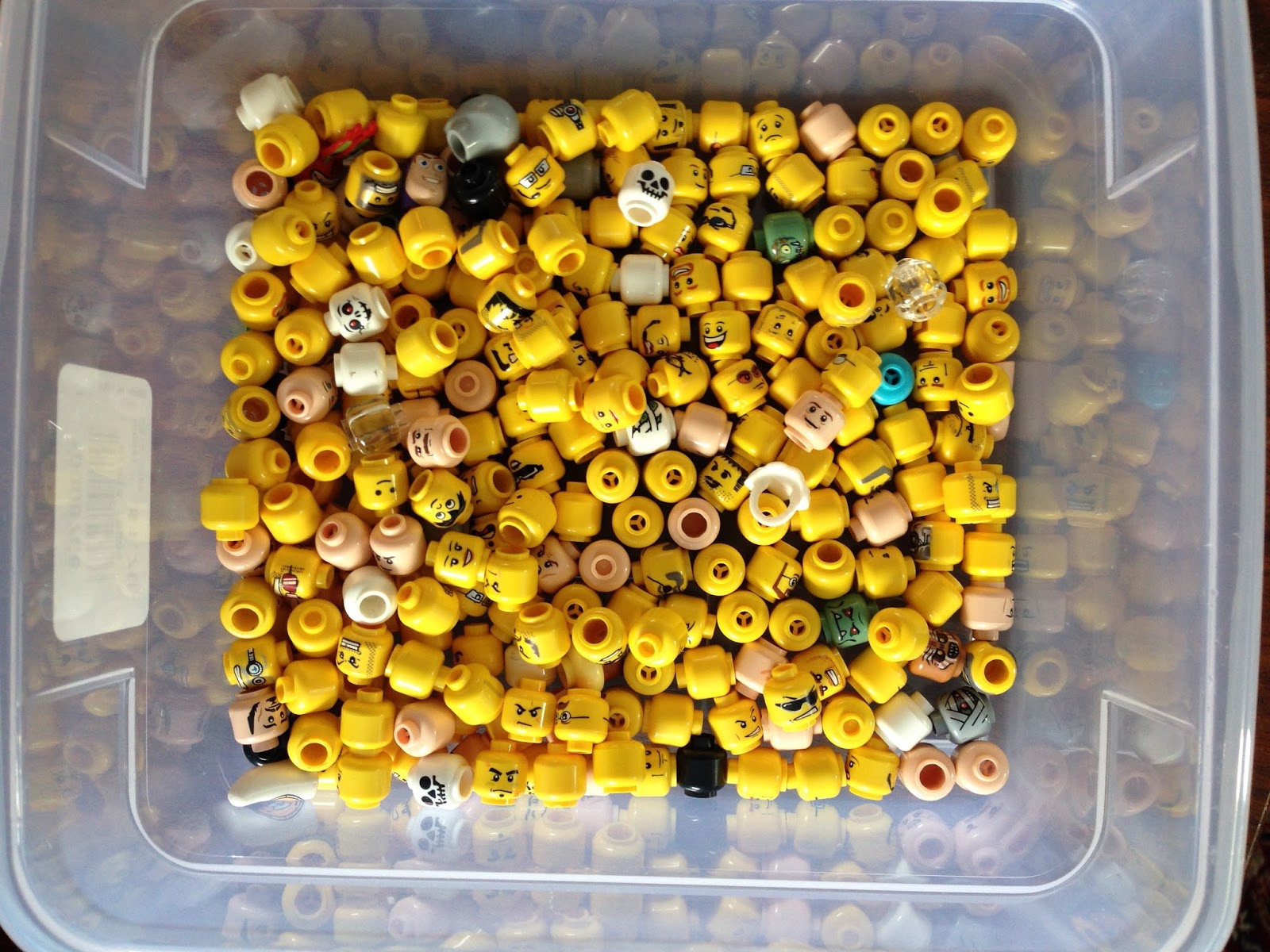
Tub of mini-figure heads. They look like garbanzo beans.

I didn't put "Cleaning the Lego Room" on my list of activities that I wanted to do after my surgery, but it is a milestone. I wasn't as flexible as I wanted to be, but I made enough progress. 

After

Tuesday, May 17, 2016

Surface Tension

While I was in Ohio, I visited one of my closet friends from high school, Betty. We went to a coffee shop after dinner and talked for about two hours. I saw her in January when I visited Ohio, but we hadn't really talked since then. Betty has a job, two young children and a husband who travels. Between her limited time and a three hour time difference, it isn't simple to keep in touch.

I talked about my life; she talked about hers. Betty is everything you could want in a friend: funny, empathetic, a good listener, caring, and intelligent. She asked me how I was doing with my mom's illness, my knee, and losing the School Board election last fall. She asked how my dad was coping with my mom's illness and his subsequent loneliness. She asked about Jack and how we were recovering from his betrayal that I first learned about two years ago. She asked about Claire Adele and the Boy. I talked about dealing with the Boy's reorganization of his teenage brain and his frustrations with friends. While the Boy is generally pleasant, he is capable of epic mood swings. As my friend Sarah says, "The Boy has a large emotional range." Yeah.  And it is awful to be on the receiving end of his tantrums.

As we were talking, I didn't think I was being excessively whiny or complaining. I was more or less giving her an inventory of my life, as we commonly do when we haven't seen each other in a while.

"How is the job search?" Betty asked.

"It has been on hold since the knee injury," I said. My daughter's piano reminded me of the emotional and physical energy required for healing. It is one thing to continue to work at a job you already have when you are injured; it is another thing to look for a new one while recovering.

"What about getting back into education?" she asked.

"The entire new School Board except one director campaigned against me," I said. "I have no clout with that group. I can't return to advocacy in the current environment. Nor do I want to. I decided to go big or go home when I ran. I lost, so now I am going home. I can't go backwards. It is really difficult that I spent nearly ten years in that arena and I really can't go back."

"Have you looked for a job at the university?" she asked. She works in a university setting and she knows we are close to UW.

"There was an opening for change management position to support the new payroll system roll out," I said. "I applied for that."

"You sound perfect for it!" Before kids, I had worked in Change Management.

"I didn't hear anything back," I said. I didn't tell her there were probably 300 other resumes that came in for that job.

"Oh," she said. I didn't tell her about the other half dozen jobs at the university I applied for. Betty paused.

"How are you managing all of this?" Betty asked.  Translation: Wow, your life is in a bad place.

I imagined myself being a tightrope walker being unaware I was 300 feet in the air, and then having someone tell me. I looked down and saw the people looking like ants while I was floating above them and freaked out. I thought, She's right. This is really hard. How am I coping?  

Betty is a dear friend and meant no malice. Her only fault was being empathic, which is the opposite of a fault. I have other empathetic friends, but this was a high density conversation about all that is going on in my life. When she asked, "How are you managing?" the surface tension which was keeping the liquid from overflowing burst. My cup was overfilled, held together by exceptional laws of physics. When the tension was released, my emotions poured out, not at that exact moment, but slowly: when I got back to my dad's empty house, when I was flying home, when I went to dinner Saturday night with Jack and the kids and the Boy decided to have a snit fit which then expanded into full blown tantrum by the end of the evening. By Sunday, I was a wreck.

It is a minor testament to resilience that I could manage to keep moving and maintain a reasonably positive outlook. At the same time, a little pessimism doesn't hurt. It is what inspires and motivates us to makes changes. Okay, I can't end on this Pollyanna note. I want to say my life is a mess and I need to clean it up, but sometimes life is just messy, and there are things that can't be cleaned up. I can't change my mom's situation. I can't go back and re-run the School Board election. I can't change that I have a teenage son who is at times my favorite person in the world and other times my least.

While on the stationary bike this weekend, I read Roz Chast's Can't We Talk about Something More Pleasant?* It is her graphic novel memoir about her parents' slow deaths. She had no control, but she could collect her insights and write them down.  I laughed in recognition when she wrote and drew "The Aisle of Tears" which sold adult diapers, adult wipes, pureed food, and other things my mother needs. She talked about the dining room at the Assisted Living Center being like a high school cafeteria with its cliques and unofficially assigned seats, which I also saw where my mom now lives, but on a much smaller scale.

Reading Chast's book made me realize that there are parts of life that just suck, and there is very little we can do about it except get through it. There is no shortcut through suffering: it is part of the human condition. Reading her book, I felt like I was in a conversation with a friend who was guiding me through the wilderness of aging parents. For now, my experience with my parents' aging is not up close, but from a distance. She turned her and her parents' suffering into art, a story that resonates with people like myself who are going through something similar.

Sharing coffee with a friend, telling her how I feel, that is good way to make it all a little more bearable.


* I used to like Roz Chast but now I love her.

Monday, May 16, 2016

Margaret Sanger and Saving the World

This weekend I finished reading Terrible Virtue, a novelization of the life of Margaret Sanger, by Ellen Feldman. I read a review of this book in Elle, and got it from the library. I returned the book as soon as I finished it so the next person on the list could read it. I was a little hesitant to read about Sanger because I had read that she was into eugenics. Someone had written that she was a wealthy woman who was into birth control for the impoverished masses, which at best sounds slimy and at worst makes her kind of a Nazi.

Thankfully, that was not Sanger's motivation.

Do you have or were you born into a family with ten or more children that were conceived not by choice? If not, you can thank Margaret Sanger and the countless early supporters of birth control. I knew birth control was an important part of American life, but I didn't realize how much so until I read what life was like before it was more readily available.

Sanger grew up in an impoverished family where her father was a drunken dreamer. Her mother had thirteen children and was physically compromised from having so many kids. This book suggests that Sanger's mother's death was linked to her exhaustion from having so many children.

Before World War I, she was a socialist, nurse and suffragette. She was asked to speak to a women's group about the vote for women, and instead she spoke about women's health. Why did wealthy white women have access to birth control when working class women and immigrants did not? The more kids they had, the deeper they and their children fell into poverty. These women also suffered terrible losses--miscarriages, stillbirths, infant death--because they lacked access to healthcare. Those multiple pregnancies took a toll on the women's bodies. Often the women would become pregnant again soon after they gave birth. There bodies didn't have a chance to recover.

Sanger's goal was not to reduce the huddled masses, but to give women a little bit of control over their destiny. She wasn't forcing birth control on these women--she was just educating people and increasing its accessibility so they could have options. Why should only wealthy woman have access to controlling their fate?

Saving the world, though, can be an ugly business, and Feldman does a nice job of exposing that. Sanger might not have been into eugenics, but she wasn't she a paragon of kindness, either. She was dismissive of her children, and could be cruel to the men who loved her.

Why do so many people--myself included--have a fantasy about saving the world? Why do we dream of accomplishing big things and want to have big ideas that will help mankind? To quote John Lennon's "Imagine," I am not the only one. Many people want to save the world, whether they are politicians, young people leaving college or thirteen year old boys. I was talking to a friend at lunch recently and I thought maybe I should just get a regular job at a company, nothing where I was trying to right some major social failing.

"That is what a lot of people think," she said. "And then they wake up realize they have been working for an insurance company for twenty years." She has a point.

We often look up to these people as heroes, but saving the world isn't what is cracked up to be. I was there for almost ten years in my volunteer work. Saving the world can be tedious, hard work. It is having to fight against people who don't believe in a cause. They step on people who do agree with them, but don't agree on every point or perspective. It might involve compromises or working with people who are disagreeable. Some people who save the world are disagreeable themselves, putting their cause above civility. Sometimes they have to because civility doesn't work. They are often not recognized as such until years of them slogging away and after their changes have been in place. Many people slog away and are never recognized.

Saving the world also takes time and persistence. It is often met with defeat and after defeat, but these people keep going in spite of that. They likely have very serious stubborn streak. They might assume that their cause gives them the right to be an ass to everyone, or be blind to the hurt they are inflicting on those they love. They might be angry or drop old friends as new and more important people take their place. Loved ones might not understand why they are called to this kind of work.

I have a good friend, Sereena, who has been an education advocate for years. Her main focus has been the opportunity gap and trying to improve outcomes for kids of color. Like Sanger, Sereena is both a dreamer and a doer.* Unlike Sanger, my friend is kind and civil. She is not hostile or abrasive like other advocates I know. Recently, she posted an article on Facebook about how the opportunity gap is still unacceptably large in Seattle.

"Why?" she posted. "After all of my work and the work of others, we are still in the same place." She was pissed.

I have been haunted by this for a few weeks. My heart breaks for her. Her head and her heart are in the right place. This woman is not a complainer or a whiner. Her volunteer and professional activities range from giving input on policy on state committees to discuss plans for the opportunity gap and grassroots work where she organized meetings with Somali mothers. She has a firm grasp on both the big picture and what it looks like for people on a day-to-day basis.

What happens when you try to fix something in society that you believe needs to be fixed, and you feel like you aren't making progress? How can some people make a difference and others who try, struggle?

My son wants to do something Big and Important with his life. He is thirteen, and wants to make a contribution now. (He could start by packing his own lunch and doing his homework without being nagged, but I digress.) Saving the world is hard, and yet there are many small things we can do to make our corner of out world a better place.

Sanger made a major contribution that makes the history books, but we need people like Sereena who work just as hard for their cause. When I think of my Sereena, I think of how worse things might have been without her. And what if she keeps going? At best, my great-grandchildren will read about her. At the very least, she has encouraged a group of kids in her corner of her world to value their education and has fought to get them to resources and support.

* I read this "dreamer and doer" line in an advertisement in the New Yorker for a college in NYC. I love the concept.

Sunday, May 15, 2016

Step Aside

Note: I've just finished Terrible Virtue, a novelization of the birth control advocate, Margaret Sanger, by Ellen Feldman. I have my feminist rant on. Be warned.

There was an article last year in my daughter's high school newspaper about walking in the hallways at the school. One of the young women at the school did an experiment at the school where she walked down the middle of the hallways and did not move out of the way. She observed what happened and then wrote about it. (I wish I could find the article online, but I can't yet. Argh. If I find it, I'll post it.)

The guys in the school were less likely to move out of the way for women. I am guessing other social scientists have studied this phenomena as well, that the more powerful people perceive themselves to be within a pecking order (i.e., upperclass white males), the less likely they were to move out of the way. The less powerful step aside.

Imagine the White House. If Obama (or any of his 43 predecessors) walks down a crowded hallway, my guess is that the group would part like Moses parted the Red Sea. Everyone would push to the side and let him pass. I doubt there is any formal written etiquette about this like royal families around the globe have. The Queen walks in front, her consort walks ten steps behind. While the President is a big example, smaller ones abound on a smaller scale, but who is to say who is more or less powerful when two people cross paths know nothing about each other? Race, gender, age, class and mental capacity take over, and not in that order. Some people can't read social cues, and will plow through a crowd stepping on toes. Most civilized people will give elderly people with a walker space. But what happens when two middle age people cross paths? Who steps aside for whom?

Here I am conducting my own little social science project with my crappy leg. I can walk, and I make a huge effort not to limp. In my effort not to limp, I pretty much walk in a perfectly straight line, no bobbing and weaving gracefully around people like a basketball star. Think of me as Frankenstein with his straight ahead, lock-legged walk. I bet people get out of his way.

I've recently been to airports, the grocery store, restaurants, walking the dog in the park, etc. Since I can't easily side step to the left or right, I am the one not stepping aside. At times, I feel like ass taking up more than my share of the sidewalk or aisle at Bartell's.

Then there are times where walking is like a game of chicken: who will budge first? Not me. I might stop in my tracks, but I don't step to the side. This isn't intended to be a power play. Once a middle aged man of color stepped off the sidewalk to let me pass. I wanted to apologize to him: I am not being a jerk. I just can't move that way that fast. 

What did I learn? The people least likely to step aside for me are middle-aged white women. I almost got plowed over a few times at different airports this week. Men will look at me and when they see I am not moving, they will step aside. I don't think these women are committing micro-aggressions, but rather they might assume a mutual, half step aside from both parties. I can't yet do that dance.